
Marginalia
An ode to things that thrive on the edges and in-between spaces
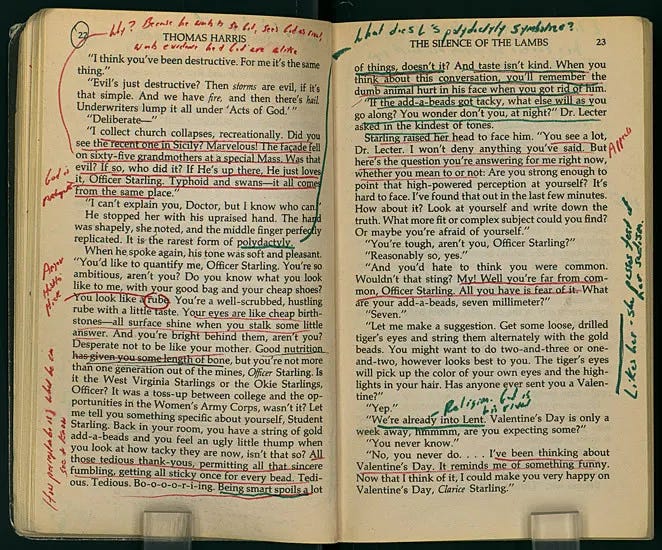
I’ll admit it: I’m a person who always, without fail, writes in books. Even if those books are not owned by me–I can’t help myself. If it’s someone else’s book, I’ll write in pencil (I’m not a monster), with the softest of strokes under the pretense that I will go back and erase it all once I’ve consumed the volume. (I never do.) I don’t feel like I’m actually reading if I’m not reacting to the words on the page in the form of marginal comments or emphatic underlining; the marking is itself part of the sense-making. As Billy Collins writes in his poem about marginalia,
We have all seized the white perimeter as our own
and reached for a pen if only to show
we did not just laze in an armchair turning pages;
we pressed a thought into the wayside,
planted an impression along the verge.
To process a written work in the form of marginal markings activates a passive moment of reading by putting you in conversation with the author. But if and when you return to the work at a later moment, it also serves as a map of your former understanding, almost like an overlay that directs you to the juicy bits and draws your attention via shortcuts to the things that once mattered to you.
Even better: reading a book that contains the marginalia of previous readers, allowing you to inhabit their and your experience of the work simultaneously. Billy Collins’s poem turns on such a discovery, as at the end he relates having discovered in a library copy of Catcher in the Rye, a scrawled plea to “Pardon the egg salad stains, but I’m in love.” My reading of a favorite book, Jenny Odell’s How to Do Nothing, was heavily impacted by the fact that I first encountered it through a dear friend’s copy that had been liberally marked and sticky note flagged by her. I could see what in the text electrified her and, knowing her, knew why, making me love her (and the book) all the more. My scribblings will similarly greet her upon her return to the text.
We’re currently occupying a marginal moment in the academic year–no longer school time but not quite yet summer–and so this week I’m ruminating on what magic can happen on the edges and in-between, with a celebration of creatures that thrive in worlds that have otherwise been abandoned and who find opportunity where others see waste. I’m curious about who in the more-than-human world is “pressing thoughts into the wayside and planting impressions along the verge.” The book is the book, but the printed words mean nothing without a reader making sense of them, leaving a mark. So often the main action is happening on the periphery, or in the interstitial spaces where worlds connect.
One way to encounter marginal creatures is to explore the concept of ferality. The Feral Atlas is an interactive website project created by a group of anthropologists interested in how, in this period many call the Anthropocene, human impact has transformed every corner of the planet. In their co-authored book associated with the project, the creators of the Feral Atlas illuminate how “at every scale, nature is changing through its entanglements with human infrastructure,” resulting in a “new Nature” that they define as inherently feral. By ferality, they mean “the state of nonhuman beings engaged with human projects, but not in the way the makers of those projects designed.” Feral beings occupy the space between the “wild” (or worlds that humans have nothing to do with) and the “domestic” (or worlds entirely under human control). For the creators of this project, human impact on the planet is extensive enough that ferality is the characteristic condition for the vast majority of beings in what we call the natural world. The experience of exploring the Feral Atlas is weblike and non-linear, presenting many pathways through essays, poems, and imagery meant to spur our thinking about the ecological relationships that emerge out of human and non-human entanglements. It is in many ways a catalog of unintended consequences, offering a view into how creatures take advantage of or suffer from human interventions ranging from the local to the global.
While the creators claim to be value neutral in their exploration of ferality, a good number of the stories told in the atlas are dire. (In their defense, how could it be otherwise?) Still, much is to be learned from the resilience of the natural world, particularly as it exists on the margins. I’ve frequently cited Biomimicry 3.8’s Life’s Principles as inspiration for how we might shape our own actions. Here are four feral species, each of which is living out one of those principles somewhere on a periphery.
Replicate Strategies that Work: Dandelions
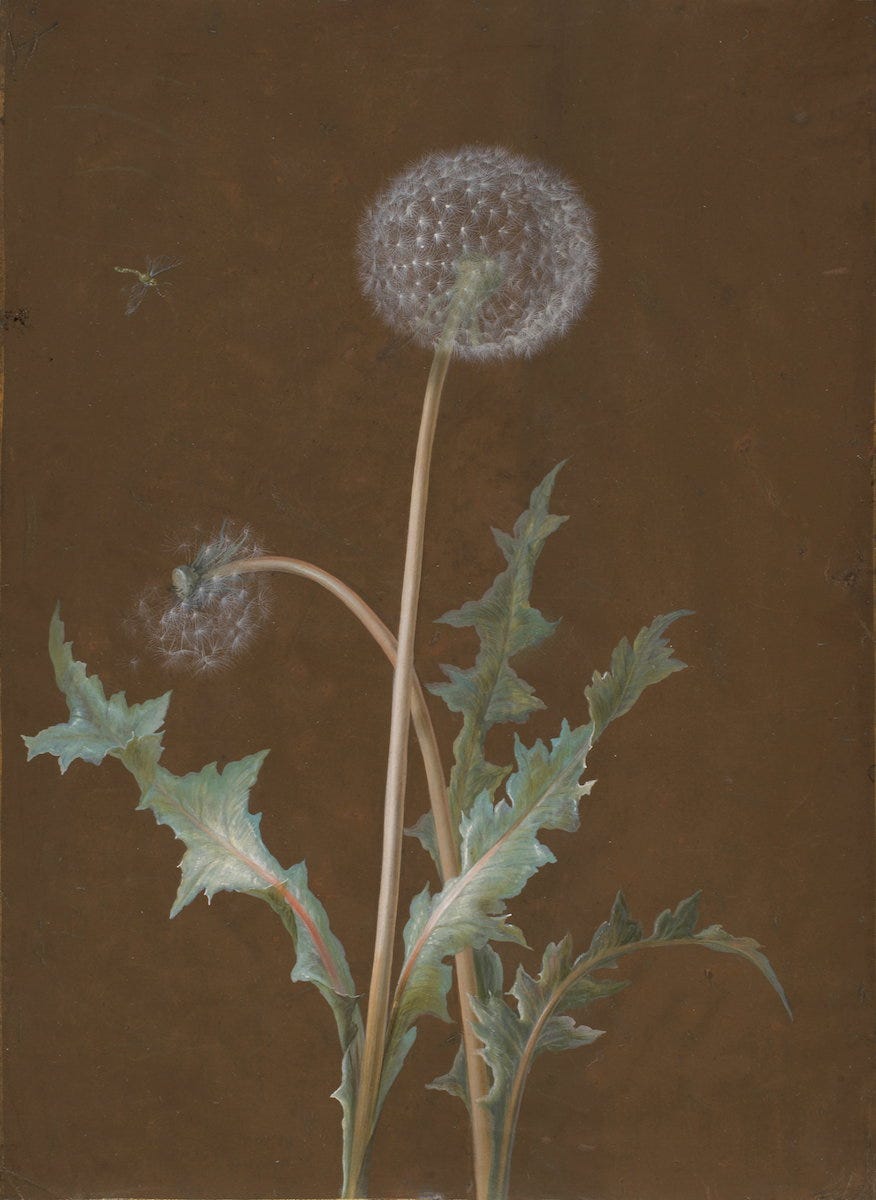
Most of my associations with dandelions come from my childhood: being tasked with the chore of digging them out from the cracks in our sidewalk using a butter knife, splitting their stems to tie together into colorful crowns, rubbing their flowers under a friend’s chin to determine whether or not she liked butter (who doesn’t like butter?!), and flipping the bloom from the stem with a flick of the thumb, while chanting (gruesomely), “Mama had a baby and its head popped off!” Universally hated by people who care about their lawns, the humble dandelion is the most feral of all the plants we describe as weeds, having been brought to North America from Europe at the time of settlement and now occupying virtually every marginal corner of the continent. The dandelion is not technically categorized as an “invasive species” in North America, despite its non-native origins, because it doesn’t pose a threat to the livelihood of native species. Instead, it studs lawns and festoons roadsides with its cheerful yellow blooms, taking advantage of sunny open spaces and delighting children (and people who recognize the dandelion’s astonishing medicinal and dietary uses) everywhere.
The humble dandelion’s success is owed to its long-term ability to replicate strategies that work. The most obvious of these is the plant’s approach to seed dispersal, as its tiny solar explosion of a flower transforms into a white puffball of threadlike bristles attached to tiny seeds. In his book, The Private Life of Plants, David Attenborough describes each seed as possessing a “complex flying apparatus, a tiny disc of radiating threads that form, in effect, a parachute. A dandelion presents these seeds to the wind hoisted on the top of a stem and arranged as a fragile elegant globe.” Since Attenborough’s writing, physicists have discovered that the bristles of the parachute create a “Separated Vortex Ring,” or an oval-shaped circulating airflow in the space just above it that helps lift the seed into the air.
Anyone who has ever blown a dandelion puffball into a breeze and watched the individual seeds disperse to the infinite corners of the planet can recognize that this plant has settled on a good plan for ensuring its enduring existence. It’s a helpful reminder to pause for a moment and consider: what are we doing that already works, that we should keep doing to hold onto what’s essential to us? Viewed another way, what are the little bits of goodness we could attach to a parachute and send out into the world, to land and set taproots into new marginal spaces, without crowding out what is already there?
Fit Form to Function: Street Dogs
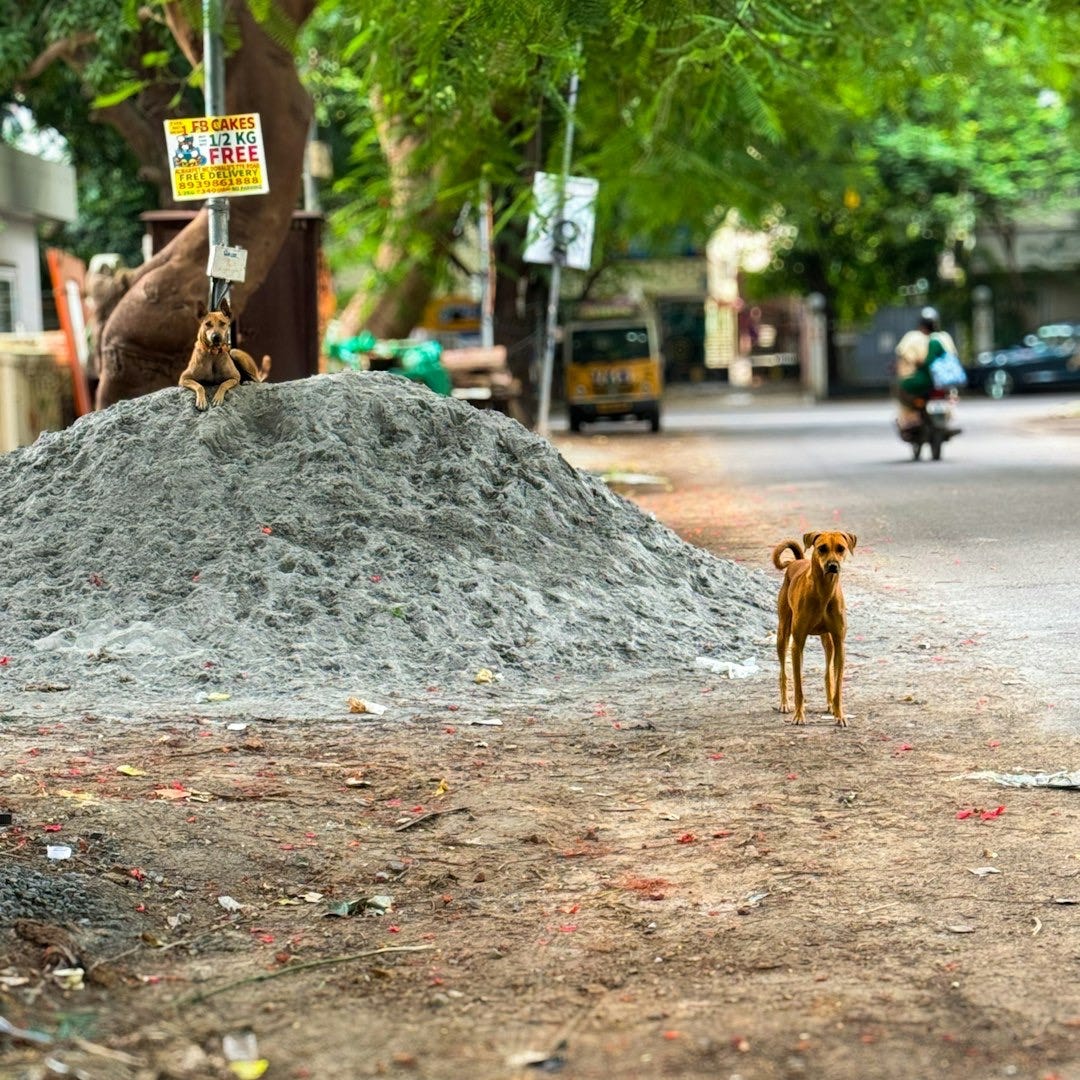
In an era when just about every other dog at the dog park is some kind of doodle, it’s worth taking a moment to send some love out to the feral street dogs of the world. Biologists Raymond and Lorna Coppinger contend that, while we tend to think only of purebred dogs when we conjure the image of a dog, in their estimation “Only Street Dogs are Real Dogs.” Dog breeds only look so different from one another because of artificial selection, meaning we humans have genetically engineered them to look like mops, or raisins, or sausages, or ornery hairless gremlins. In fact, the 75% of the world’s dogs that control their own reproduction (i.e. street dogs) more or less look exactly alike because they’ve evolved to fill a particular niche (i.e. wandering the streets dodging traffic in small packs and scavenging for food). The Coppingers describe how well-suited the medium-sized, mostly brown short-haired street dog is to its particular niche, a niche that emerged as soon as humans switched from hunting and gathering to agriculture, creating settlements that resulted in accumulation of waste. With compact, lithe bodies, street dogs require fewer calories than, say, wolves to survive and have developed a keen ability to find and feed on the garbage produced by humans, which also costs very little energy output on their part (given that they don’t have to hunt and kill what they eat). “Why are dogs nice to people?” the Coppingers write. “They are the source of food. Dogs find some food source that arrives daily and they sit there and wait.”
Having had a dog who routinely sought out a construction worker who had fed him a full slice of roast beef and who could often be found lying in the vicinity of his food bowl right around meal time, I can say with confidence that this aptitude for finding and befriending human sources of food is an evolutionary gift of most dogs, domestic or feral. But there is something to be said for the village dogs who have, over time, evolved into efficient foraging machines. While I’m certain their life is not an easy one, I think there is a lot to learn from how they manage to take advantage of marginal spaces like town dumps and trash heaps, navigating that existence with bodies that quite sensibly fit their form to such a function.

Use Readily Available Materials: Marabou Storks
Speaking of town dumps: in an essay tucked into the Feral Atlas, anthropologist Jacob Doherty explores the role of Marabou storks in Kampala, Uganda, in managing the growing city’s waste. The birds are recent migrants to the city, and they are widely detested by most of Kampala’s residents who are unnerved by their ubiquitous presence, particularly given their massive size (4-5 feet tall with an 8-10 foot wingspan) and unsettling resemblance to Skexis from Jim Henson’s The Dark Crystal. In particular, the storks are reviled for their blatant disregard for the class segregation of the city, as they “flourish in filth and defecate in the heart of greenness,” feeding in landfills but preferring to build their nests in the green, leafy hilltop neighborhoods dominated by the city’s elite. Marabou storks collectively consume upwards of seven metric tons of waste per day, or 210 tons per month, dispensing with about 3% of the solid waste generated in the city. The garbage they eat is specifically leftover food, which tends to be heavy and wet; as Doherty writes, “organic wastes are the staple of the Marabou storks’ diet. By eating them, they not only remove them from the waste stream but also reduce the amount of rotting matter that could carry threatening pathogens.” And, importantly, the storks are not hated by all residents of Kampala: the hundreds of human salvagers who make their living picking inorganic waste from the landfill welcome the storks and appreciate the degree to which their avian partners clear the way for them to find useful items that might otherwise be buried under rotting food leftovers.
Like street dogs, Marabou storks are making use of readily available materials, consuming that which has been cast off by others. What I especially value about Doherty’s essay is how it illuminates the complexities of the inter- and intra-species relationships emerging in Kampala, recognizing the inequities emerging out of the city’s rapid growth while also considering the perspectives of various human and non-human players within the system. It’s a reminder to zoom out when considering how we allocate our resources and examine how we can maximize our use of what we have at hand, while also valuing the needs of those most deeply affected.
Recycle All Materials: Fungi
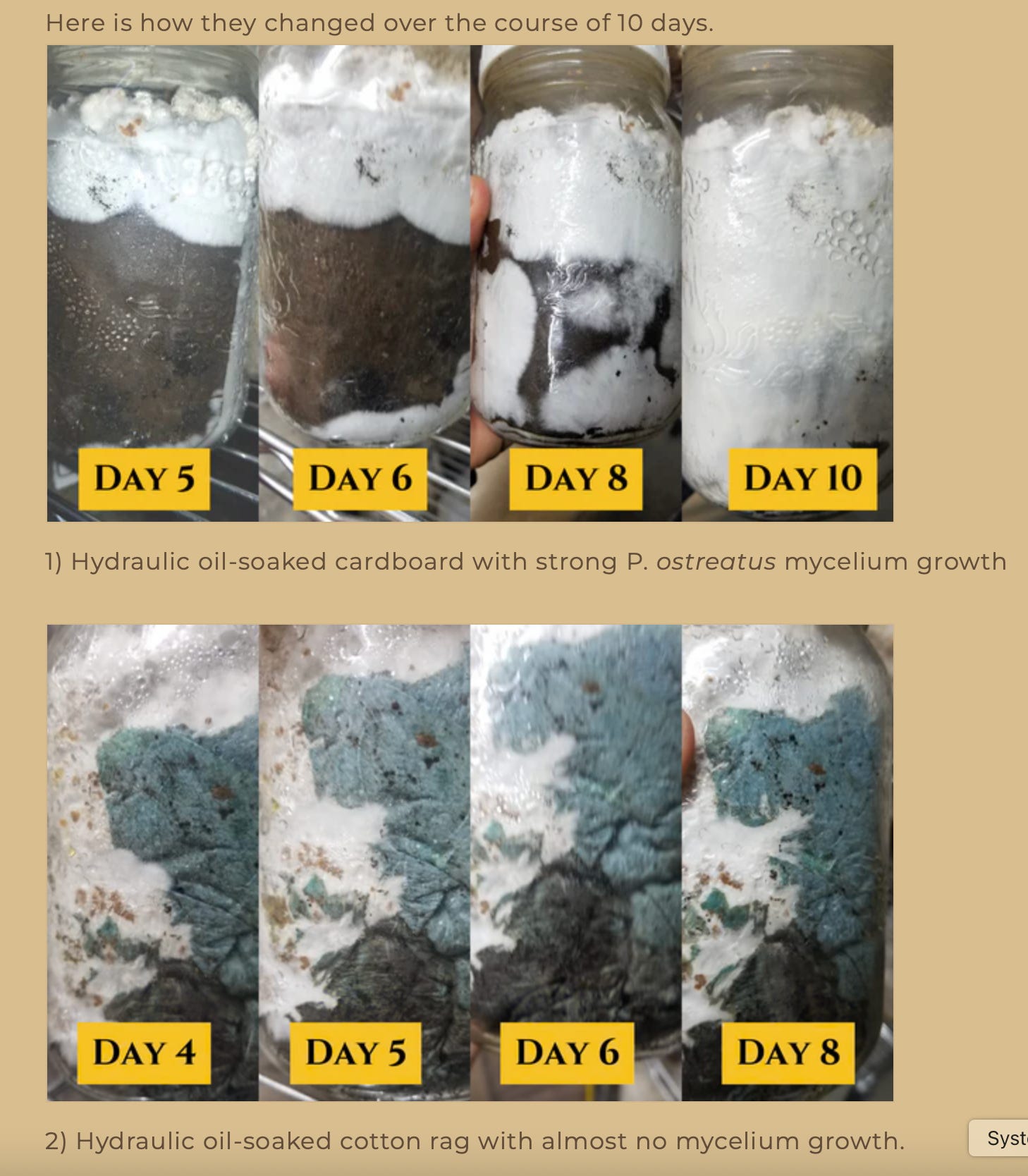
Marginal spaces are often where we relegate our waste, casting off the things we no longer need or want, or abandoning that which no longer serves us. That makes them the special preserve of fungi, particularly those species that specialize in processing and breaking things down. In the late 1990s, for example, Nelli Zhdanova returned to the site of the nuclear disaster in Chernobyl and discovered abundant black mold that was thriving in spaces still poisoned by radiation. While radiation harms most living creatures by shredding DNA and damaging cell structures, radiotropic fungi seem to be able to use radioactive energy to fuel their growth. In recent years, a whole movement towards “Mycoremediation” has emerged, meaning the practice of employing fungi to break down toxic substances into less toxic forms. Post-industrial cities like Cleveland contain neighborhoods full of run-down uninhabitable houses that hold toxic materials such as lead and asbestos; in many cases, virtually the entire house can be demolished and mixed into substrate and then composted by added mycelium. Toxins are captured by the fungi, and leftover substrate is then recycled and reused by being pressed into “mycoblocks” that can be used for rebuilding, or for other useful products including leather alternatives and biodegradable caskets. We’re only beginning to understand how fungi might help us clean up our toxic waste, such as this experiment in which someone placed oyster mushroom mycelium in jars filled with rags soaked in hydraulic oil from a tractor hose leak and three months later the fungi had completely digested the rags:
Or this effort to clean toxins out of New Delhi’s polluted air. It makes me think about reframing what it looks like for something to die or fall apart or come to an end: what is leftover in the wreckage, and how can we process and reassemble it into a different form?
To write in the margins of a book is a semi-scandalous act, graffiti in miniature, the leaving behind of one’s presence on the tucked away edges of an object that was once the pristine creation of its original author. If to produce marginalia is, as Collins writes, to press a thought in the wayside, plant an impression on the verge, it behooves us to consider what had already made its mark in waysides and verges–what has, before us, learned how to adopt ferality and take advantage of the opportunities that exist in the in-between. What is on the edges of our own existence (our work, our daily practices, our imaginations) that we can launch to the four winds, scavenge, repurpose, reuse, or metabolize to create something useful and new?