
Interstitionary Organizing
Could a Little-Known Organ Reshape How We Work Together?

There was something about COVID lockdown that motivated me (I suspect many of us) to attend Zoom gatherings with random strangers. I joined trivia nights, happy hours, symposia, and meetups. I even created my own weekly gathering of friends I knew from different corners of my life, and each week we got to know each other by answering one of the 36 Questions that Lead to Love. (Reader, it led to love.) Maybe it was the prospect of talking to somebody, anybody, other than our families, or perhaps it was simply the loss of the experience of being in the vicinity of strangers in the world that made us want to jostle up against folks who were unknown to us. We craved proof that the multitudes still existed, that they, like us, were enduring the paradoxical jolt of feeling simultaneously very much alive and shut off from what most contributes to our sense of aliveness.
Five years out, I haven’t attended a Zoom gathering with random strangers in a long while, with the exception of one I joined this past week that reconjured the buzzy thrill of those quarantine-era meetups. Dubbed an “Interstitionary Storytelling Event,” the meeting drew together a range of people who are all drawn to the work of Jennifer Brandel, whose 2023 Orion Magazine article, “Invisible Landscapes,” highlighted the interstitium, a newly discovered organ in the human body, and considered it as a potent metaphor for a very particular way of being and working in the world. Like many of the other participants on the call, I was drawn in first by the accompanying episode of the Radiolab podcast featuring Brandel. Then I read the article and suddenly: so much of what I had been thinking about recently but couldn’t put a finger on made a lot of sense.
As Brandel explains, the interstitium is a layer of tissue with a fractal, honeycomb-like structure that exists throughout our bodies, appearing a bit like a sponge. It serves as a sort of molecular superhighway as a clear fluid moves within it, carrying all sorts of bits and bobs from one place to another. Among other things, it appears to explain how cancer travels to the lymph nodes, as interstitial fluid helps create lymph which is a fluid that drains into the lymphatic system.
The interstitium was unknown to Western medicine until its “discovery” around 2018, when new internal scope technology allowed it to be seen inside living bodies. Previously, in order to be studied, tissues were removed, dessicated, treated with chemicals and dyes, and sliced up in order to be viewed on microscope slides, rendering the interstitium invisible (as the spongelike structure collapsed).
(As an aside, this strikes me as a perfect demonstration of the misguided hubris of Western ways of knowing. We remove life from its living context, slice and dice it and dress it up, blast it with chemicals, flatten it and place it under a spotlight, and then declare that we understand it fully. It’s the medical version of Plato’s cave. Eastern medicine, of course, has understood the interstitium for centuries: see acupuncture.)
Like me and like the other thirty-odd people on the call last week, Brandel is excited by the interstitium not only because it’s just freaking cool but also because she understands the organ as a metaphor for her way of being in the world. ”If anthropomorphizing a body part is wrong,” she writes, “I don’t want to be right.” In the essay she unpacks how learning about the interstitium made something click for her in understanding how she functions. She defines herself as an “interstitionary”: “We’re misfits who work on a systems level, transcending any one function and making no sense in a world that wants to explain and contain everything into discrete categories.” While I didn’t hear everyone’s story, it was electrifying to be in a space (even if it had to be virtual) where others were equally intrigued by interstitial ways of being.
Interstitionaries are people who can recognize links across different segments of an organization, or across organizations and projects, and who seek to link those efforts together. They are folks who might be continually starting new projects in pursuit of a cross-disciplinary thorny problem that they’ve identified. They carry ideas and initiative from one place to another, fostering collaborations and building mutualisms that might not have erupted otherwise. They know lots of different kinds of people, and create connections among them. Yet they tend to remain largely out of sight, because “their impact transcends any one area, and has been essentially hidden from how we organize, track, measure, and reward people in our economy and society.”
I’m here to declare myself as an interstitionary wannabe: a person who is endowed with the instincts and wherewithal to function as a conduit for emergent connectedness, an ability to envision what that could look like, but who is equally embedded in structures that disincentivize acting on those instincts and (until now) without the language to capture and communicate what that could look like. At the Interstitionary Storytelling Event, Brandel shared this chart to illustrate the differences between how we think and function, and what we value, in organizations/companies/institutions, and how that might change should we approach the work as interstitionaries (the chart is also available on her website):
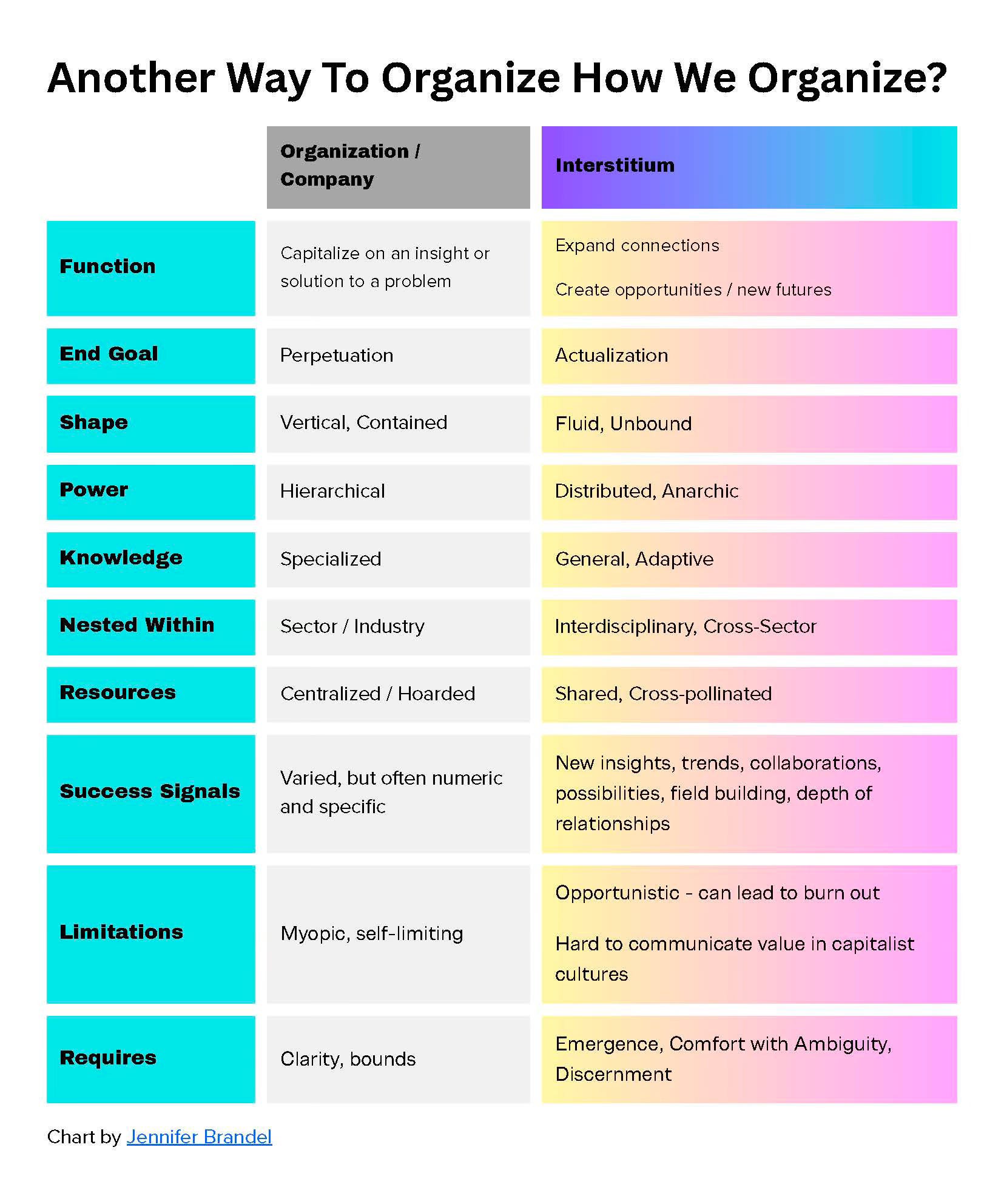
I’m so deeply drawn to so much of what is in the column on the right, and not only because she gave that column a snazzy ombre color scheme. When I compared the two, I immediately recognized the very things I bump up against within the systems of structures of higher education. Essentially, I often find myself trying to bring about the interstitionary rainbow world in a system mired in the gray. I’m excited, and admittedly a bit daunted, to consider:
What could “fluid, unbound shape” look like in the context of a college? Academic institutions are largely a constellation of departments and units that manage their own budgets and set their own agendas and frequently vie against each other for resources or attention. What if we found a way to spill out of our containers a bit? How might we foster a little bit of dynamic disequilibrium, and live into collective seepage and flow?
Higher education is the epicenter of specialized knowledge, and it continues to train students as though their purpose is to become experts in a field. What if we expanded the definition of “expertise” to value multiple intelligences and to reward the pursuit of range? What if the thing we focused on in educating our students was their facility for creating connections, rather than trying to replicate old organs with predictable functions?
Like in the business world, higher education has become obsessed with “metrics” as a way of documenting success. But teaching and learning are messy human endeavors, and there is much that can’t be measured in surveys or reported in numbers. Yet, what we measure becomes what we value, and subsequently shapes where we dedicate our resources. How might we recognize experimentation with new approaches as measures of success, even if those experiments don’t ultimately succeed? How can we lift up the fuzzier, more relational projects that advance our work but can’t easily be sliced off and pinned down to a microscope slide?
Given that the purpose of higher education has long been to find answers–to create knowledge that solves the world’s mysteries- comfort with ambiguity over clarity is a particularly tough sell. Yet ambiguity is clearly coming for us, as we live in a world increasingly marked by brain-breaking, constant change. As we look collectively at our institutional future, clarity of answers might not be possible, but what if we had clarity of common questions we were exploring as an academic community? I deeply appreciate that Jennifer Brandel more or less writes her resume this way: as a list of animating questions that have driven her work over the course of her career. We can no longer afford to be a set of disparate units all pursuing different questions. What are the common inquiries we can all find our way into, and who can move between and among us to aid us in that?
In the Book of Delights, the writer Ross Gay tells the story of a student of his named Bethany, who, in thinking about how she wanted to show up as a teacher in the classroom, said, “What if we joined our wildernesses together?” Appropriately, Gay interprets this at the interpersonal level: the idea that we all carry with us a vast territory of sorrow and that those maps might be stitched to one another (creating an ecotone!) to allow for cross-pollination and connection. I wonder about this idea at a societal or institutional level: the active building of interstitial tissue across seemingly separate ideas and endeavors, the fabrication of fascia that can remain invisible, for all I care, as long as it is functional.
To change an institution in this way seems unfathomably challenging. I still find it hard to give language to this stuff. On our call, Brandel described it as being “hem-jawed,” a concept drawn from the Dictionary of Obscure Sorrows: “feeling trapped inside your own language, struggling to shake away the baggage weighing down certain words, unable to break out of its age-old structures and melodies, frustrated that the scattering of verbal pigments on its palette could never quite capture the colors in your head.”
But change is possible: we made these systems and we can also unmake them. Neil Theise, who was one of the co-authors of the study announcing the discovery of the interstitium, and who also wrote the amazing book Notes on Complexity, reminds us, “Neither we nor the universe is machinelike. A machine doesn’t have the option to change its behavior if its environment changes or becomes overwhelming. Complex systems, including human bodies and human societies, can change their behaviors in the face of the unpredictable.” What would it take to transform higher education in ways that allow for dynamic and collaborative organizing practices? First and foremost, it would require identifying, cultivating, and rewarding the interstitionaries in our midst.
Thank you! I was also at the lovely storytelling event. I'm going to send a link to this article to another Interstitionary who couldn't make it.