
Entering the Ecotone
A Letter to My Daughter on her 18th Birthday
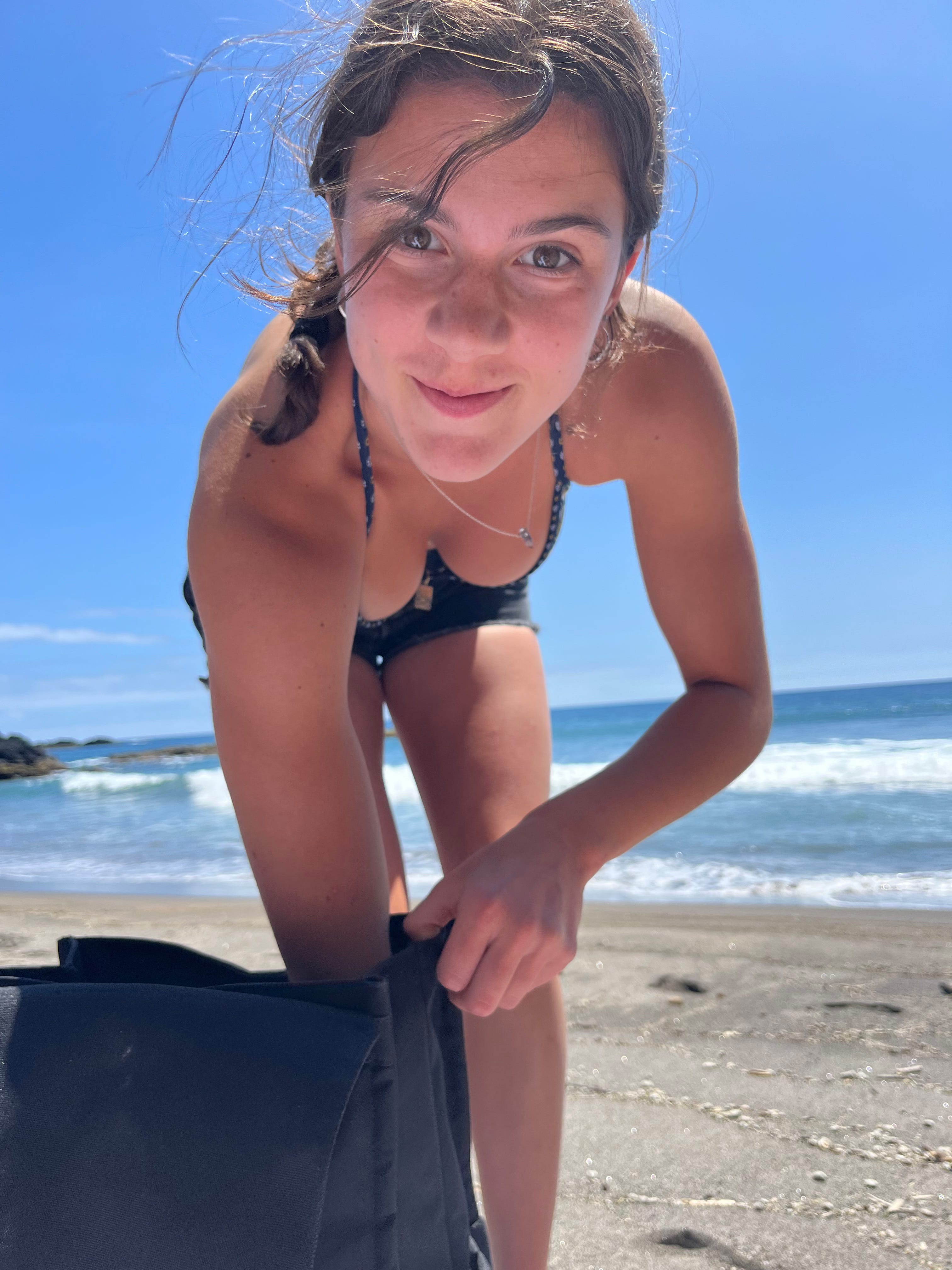
Dear Dahlia,
Putting one’s writing into the world can be daunting, like singing into a deep canyon and not knowing if anyone but you can hear your voice echoing off the walls. When I started this Substack project, I told you I would write one specifically for you, and I know at least you’ve been listening to the singing because each week you remind me of that promise, and each week I tell you: I’m not ready yet.
But you turned eighteen on Monday, and now you can tell everybody: this is your song.
When I was in Aotearoa/New Zealand this last November, I learned that there is a place at the very northern tip of the North Island called Te Rerenga Wairua/Cape Reinga, which is a rocky promontory that juts out into the ocean and hosts a single, 800-year-old wind-beaten pōhutukawa tree. According to Maori tradition, when people die, their spirits make their way up the coast to this place and transition down into the afterlife by being channeled into the sea through the roots of the pōhutukawa. While I didn’t have a chance to visit this place while I was there, the story made me think a lot about coastlines as liminal spaces - places where earth meets sea and that are both and neither at the same time. They’re a good place to think about transitions.
We sat on the sofa on Monday, your body, now as big as mine, cradled in my arms in a ridiculous return to our earliest style of embrace, and talked about the transition that was your birth. How the experience was so intense for me that I couldn’t handle the sensory overload of watching or touching it as it happened. I kept my eyes squeezed shut and declared the obvious urgency of your arrival with a gutteral voice. But then, once we’d crossed the threshold of separating our bodies and you began your life, I was all senses, touching every part of you, locating the swirl of hair adorning the middle of your back, smelling your sticky head, hearing your first alien sounds.
You were at a threshold moment on that day in 2007 and you’re at one again. The crossing of thresholds is an integral part of human existence, and that’s why it’s baked into virtually every story ever told. I don’t know if your schooling has ever exposed you to the “Hero’s Journey” narrative structure, but when I was in maybe 9th grade, in true nerd form I checked out a bunch of VHS video tapes of a PBS documentary called “The Power of Myth” from the library, in which a guy named Joseph Campbell shared a whole bunch of common patterns across different cultures’ mythologies, one of which was the hero’s journey. Many of the stories you know and love follow this pattern, including Harry Potter. While I won’t map the whole thing here, it always begins with a call to adventure (the Hogwarts letter), followed by the crossing of the first threshold, which is the main character’s first step beyond the familiar (Platform 9¾ at King’s Cross Station).
I know you’re still waiting for an owl to deliver a letter telling you you’re a witch. It’s not going to happen. Nevertheless, your call to adventure is clear and you’re poised to enter and traverse the liminal, between space that is the transition to adulthood.
Because we’re both ecology nerds, I’ll return to the metaphor of the coastline, which is an example of what is called an ecotone. An ecotone is a convergence zone where one ecosystem gives way to another, “where elements that are usually separated thrive in friction,” according to biologist and filmmaker Rüdiger Ortiz-Álvarez. It can be as narrow as a treeline on a mountaintop or as gradual as the intermixing of fresh and salt waters in an estuary. Ecotones are not only on land but also in the ocean, as changing conditions related to depth, pressure, and oxygenation result in shifting marine ecosystems. The cool thing about ecotones: species density and ecological diversity are often at their highest in these in-between territories, as the convergence of habitat features make so much possible.
You are in one of life’s ecotones - on the edge of child and adult, neither one nor the other and both all at once. Past you and future you have been separated, but they are about to thrive in friction. This summer you’ll be literally traversing an extended ecotone as you make your way across the continent from the New England forests you know so well, across endless grasslands turned farmland, and into the foothills of the Rockies. To complicate matters, you are also entering adulthood at a historical moment that feels like an ecotone: so much is colliding right now, so much in flux, so much in transition. It’s hard to know what future we’re on the precipice of.
Here’s the good news: you have the capacity to thrive in a range of microclimates - you just don’t know it yet. You were a very picky newborn, unwilling to be put down and in need of both constant motion and as tight a burrito swaddle as you could get. But as soon as you came to terms with being out of the womb, you transformed into the most adaptable of creatures, capable of absorbing and thriving in the midst of so much change. Your life has provided you with ample opportunities to practice resilience, and since a young age you’ve been making your way between and across household ecosystems, creating your own ranging habitat that is enriched by your presence there. You’ve taken advantage of an ecotone existence practically from the get-go.
I know this transition feels hard. (Please know there is nothing more painful than being a mother watching your child grieve the potential loss of the things she cherished from her childhood.) It’s meant to be hard. Crossing a threshold is always inevitably painful and exhilarating. Just like your birth, it will be both of those things for both of us.
But now it’s time to be like a sperm whale: take the liquidy stuff in your body, cool it down and firm it up and use its solidity to dive deep. Swim across the ecotones and explore what’s down there. You’ll know when to release the blood supply to warm it all up and buoy yourself to the surface again.
I know you know this in your head but if there’s one thing I can help you take on in your heart, it’s the beautiful, terrible truth that nothing is fixed and everything changes. Your very body is an event (as I always say to grandma and she rolls her eyes). We are constantly breathing the world in and out, taking its particles into ourselves and releasing our particles to become part of it. Grief is a sign that you’re doing it right, that you’re paying attention to and taking on what’s good in the world. It means you also know when to let it go.
Back to New Zealand and coastlines: while I was there I visited the Auckland Art Gallery, where there is an exhibition of works depicting the New Zealand coastline. I learned from one of the information plaques that in the late 1960s, the artist Colin McCahon established a studio off of Muriwai Beach (about a 6 hour drive south of Te Rerenga Wairua). It was a place where he experienced a major period of creative productivity, about which he wrote to a friend: “I have years of painting to do before I catch up with beauty and freedom.”
Knowing your spirit, my chickadee, you will never, ever catch up with beauty and freedom. You will forever be a person who weeps at eclipses, whose heart breaks catching sea turtle eggs, who collects moth wings, who dances when she eats, and who loves the world and the human and non-human creatures in it with her whole body. The Maori word for earth - whenua - is the same word for placenta, and even though your placenta is not technically buried in the woods of Vermont, this place will forever be tied to you and you can always come back to it.
You have everything you need to do the crossing. I was there at the beginning and I’ll be there the whole time.
Love,
MarMar
So beautiful, Erin! Loved reading this!